All-on-6 dental implants in Alanya, Turkey
All-on-6 replaces a full set of teeth in one jaw with a fixed bridge on 6 implants. Like the foundations of a building, the 6 implants share the load, which gives the bridge firm support. All-on-6 suits people with enough bone who want extra support for their new teeth. We plan the treatment from start to finish at our clinic in Alanya.
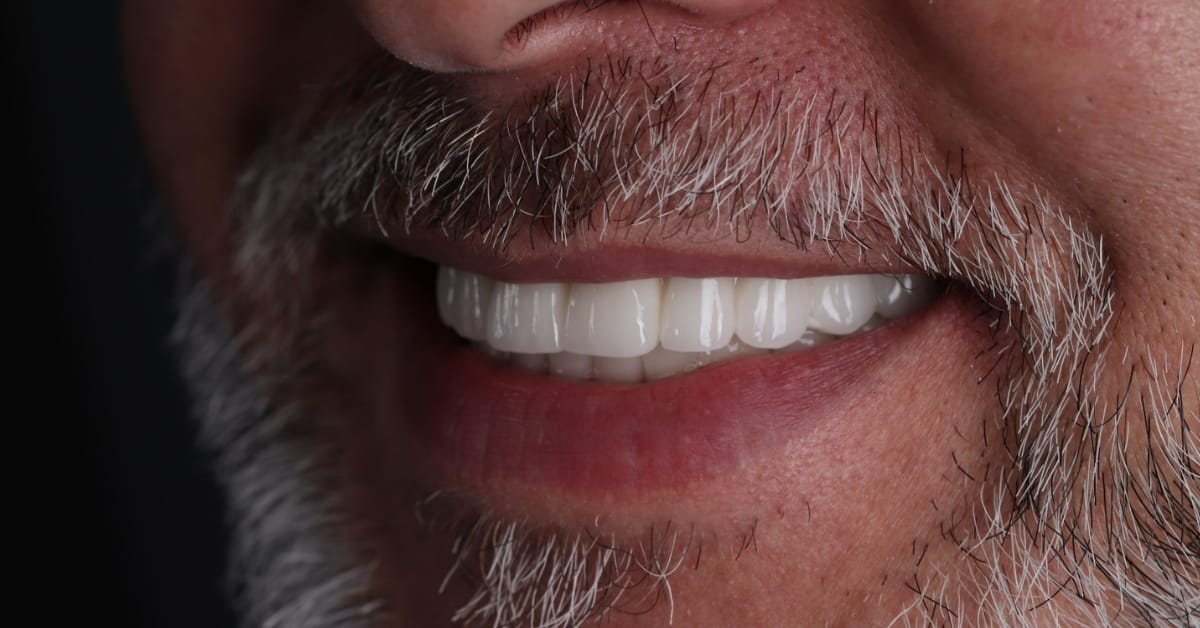
All-on-6 is for people who have lost all or most of their teeth. Six implants hold the new teeth, and the aim is teeth that work well and look natural.
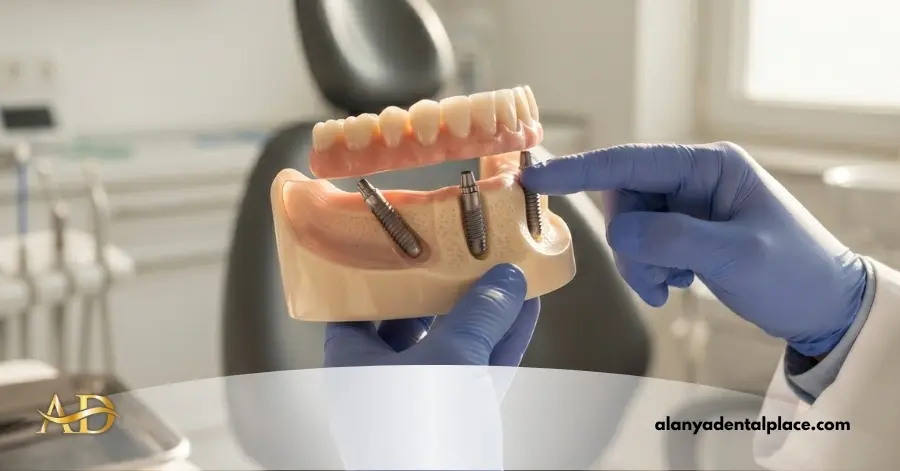
What is All-on-6?
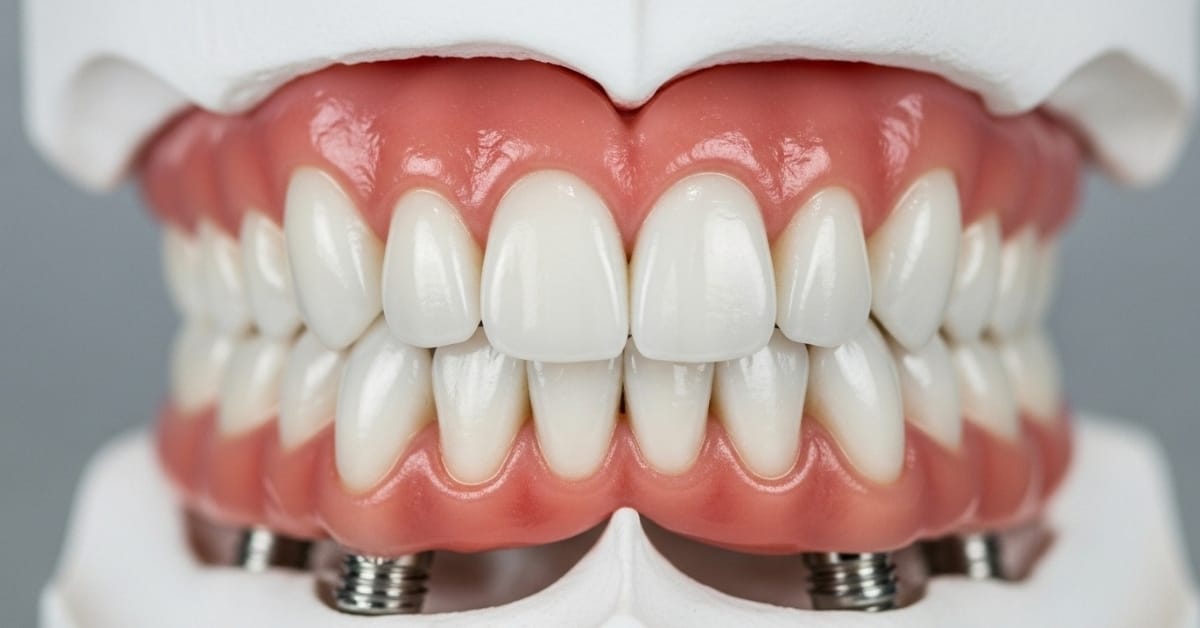
All-on-6 replaces missing teeth with fixed teeth. A full set of teeth for one jaw is held by just 6 implants.
It is for people who have no teeth left in a jaw, or who have lost most of their teeth.
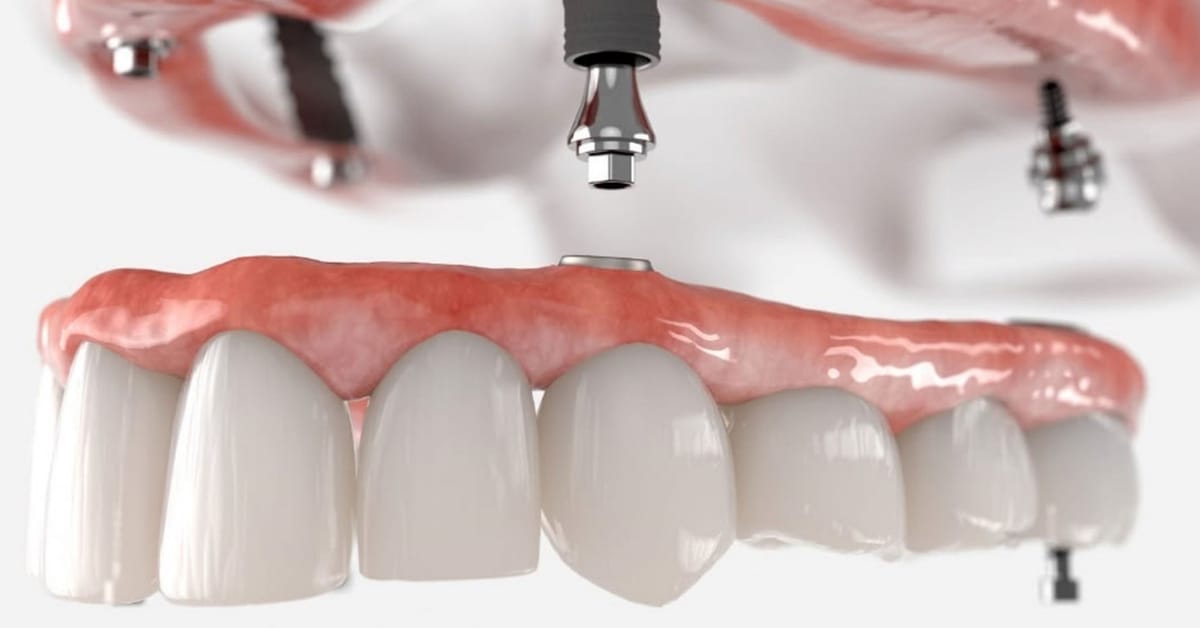
The name means that 6 implants support a full arch of teeth. The implants are placed at planned points and angles. There are 2 at the front of the jaw, 2 in the middle and 2 at the back. Together, they form a base that spreads the weight of the bridge and the chewing forces over a wide area.
Many patients ask us how All-on-4 and All-on-6 differ before they choose.
The 2+2+2 layout
The main difference from All-on-4 is not only the number of implants, but how they are spread along the jaw. The 2 front implants go in straight and the 2 middle ones at a slight angle. The 2 back ones are tilted more, to avoid the sinus and nerves. This shortens the unsupported end of the bridge (the cantilever), so more teeth sit directly over implants.
Could All-on-6 suit you? We can check your X-rays.
Full-mouth implants or dentures?
Many people who lose most or all of their teeth start with removable dentures. Dentures fill the gaps, but they do not protect the jawbone underneath. Over time, this can become a bigger problem than it first seems.
The jawbone shrinks if it is not used
When you chew, natural tooth roots stimulate the jawbone, which helps it keep its volume. When a tooth is lost, this stops and the bone slowly shrinks. Removable dentures do not stop this; they only hide it. As the bone thins over the years, dentures get looser and the lower face can sink in. Implants stimulate the bone in a similar way to natural roots, which can slow this shrinking.
Chewing, not just appearance
With a removable upper denture, you bite with much less force than with natural teeth. Many people stop eating hard or chewy foods. A fixed bridge on implants can bring chewing force closer to that of natural teeth. It also does not move when you speak, so it does not affect your speech.
Bone support
Chewing strength
Everyday life
Full-mouth implant treatment, whether All-on-4, All-on-6 or All-on-8, is not the same for every patient. What they share is fixed teeth that replace lost teeth, for chewing and bone health as well as appearance. The right option depends on your bone and what you expect, so we compare the options side by side below.
Contents
Who is All-on-6 for?
All-on-6 needs a little more bone, and slightly denser bone, than All-on-4. So checking whether you are suitable is even more important.
When is All-on-6 a better choice than All-on-4?
With All-on-4, only 1 or 2 teeth can extend unsupported behind the back implants (the cantilever). More back teeth put extra load on the bridge. With All-on-6, 2 more implants carry this load. This can be a safer design if you clench your teeth or need a wider chewing surface. Also, with 6 implants, losing one implant does not put the whole bridge at risk. With 4 implants, each one is essential.
Who needs a more careful assessment?
If your bone is limited, All-on-6 may need a bone graft or sinus lift in some areas. In this case, the tilted implants of All-on-4 may suit you better. Diabetes that is not well controlled, severe osteoporosis or heavy smoking can make healing harder with both methods. The final decision is made after an assessment of your CBCT scan.
How is All-on-6 done? Planning the surgery
What makes All-on-6 work is where the 6 implants are placed along the jaw.
Digital planning and guided surgery
Before surgery, we take a 3D scan (CBCT) at our clinic in Alanya. It shows your bone density and where the nerves and sinuses are, to the millimetre. The position, angle and depth of the 6 implants are planned on a computer. A 3D-printed surgical guide then transfers this plan to your mouth.
Same-day fixed temporary bridge
If the implants are stable enough during surgery, a fixed temporary bridge can be fitted on the same day. This means you leave our clinic with teeth, not gaps. You use the temporary bridge in daily life while the laboratory makes your permanent bridge.
How many teeth does the bridge have?
A full-arch bridge on 6 implants usually has 12 to 14 teeth. This means that almost your whole chewing surface is supported by implants. Because the unsupported back end (cantilever) is shorter, the back teeth are closer to the implants and better supported.
The All-on-6 treatment process
At our clinic in Alanya, All-on-6 treatment has 7 clear stages.
You send us your panoramic X-ray or CBCT scan on WhatsApp. Our dentist looks at your bone and gives you an initial assessment and information about the costs.
When you arrive in Alanya, the dentist examines your mouth in detail and takes a new CBCT scan. At this stage, it becomes clear whether All-on-4 or All-on-6 suits you.
The dentist plans the position of the 6 implants on a computer, and a 3D-printed surgical guide is made.
Any teeth that cannot be saved are taken out at the same appointment. The 6 implants are then placed in the planned positions.
If the implants are stable enough, your fixed temporary bridge is fitted on the day of surgery.
You go back home. Over 3 to 6 months, your implants join with the jawbone.
At your second visit, the dentist takes impressions, fits your zirconia or hybrid permanent bridge and makes final adjustments to your bite.
Your first visit usually takes 5 to 7 days, and your second visit also takes 5 to 7 days. In between, you need 3 to 6 months to heal.

We can help you plan your visits



Implant brands we use
What affects the cost of All-on-6?
The cost depends on your treatment plan. All-on-6 usually costs a little more than All-on-4, because it uses 2 more implants.
Your final treatment plan and costs are confirmed after a CBCT scan or X-ray.
What affects the cost
The total cost mainly depends on the implant brand, the bridge material and how many teeth need to come out. In rare cases, a bone graft or sinus lift adds to it.
Send us your X-ray and ask about your treatment plan
Full-mouth implant options: which suits you?
There is no single right answer to “All-on-6, All-on-4 or another method?” It depends on your bone and what you expect. Below, we compare the main options side by side.
All-on-4
It uses 4 implants and often avoids the need for a bone graft. It usually takes less time and costs less than options with more implants. Only a few back teeth can be supported (the cantilever limit), so All-on-6 may be safer if you have a strong bite. Our All-on-4 page explains it in detail.
Number of implants
Most suitable for
All-on-6
As explained above, its 6 implants give a wider base and more support for the back teeth. It sits between All-on-4 and All-on-8 in both stability and cost.
Number of implants
Most suitable for
All-on-8
This option uses 8 implants. It spreads the load most widely and is the most durable of the three. It is usually chosen for a very wide jaw or a very strong bite. It costs more than All-on-6 and is not needed for everyone. Our All-on-8 page explains it in detail.
Number of implants
Most suitable for
Zygomatic implants
Sometimes bone loss in the upper jaw is so severe that even All-on-4, with its tilted implants, is not possible. Then zygomatic implants may be an option. They are much longer than standard implants and are fixed in the cheekbone (zygoma) instead of the jawbone. The cheekbone is dense and strong, so this can give stable support without waiting for a bone graft. It is a specialised technique that needs advanced surgical skills.
Number of implants
Most suitable for
Conventional implants
This is the traditional way, with a separate plan for each tooth. It uses more implants, so it usually needs more bone grafting and takes longer. It is still a good option if you are not short of time and prefer treatment in stages.
Number of implants
Most suitable for
Removable dentures
Dentures are still an option if you cannot have surgery, or if implants are not within your budget. As explained above, they do not protect the jawbone and chewing strength is limited. They also need more maintenance, and replacing over time.
Number of implants
Most suitable for
All-on-6: risks and how long it lasts
We think it is important to explain the real risks of All-on-6 clearly.
Possible problems include an implant not joining with the bone (osseointegration failure) and inflammation around the implant (peri-implantitis). Rarely, there can be problems in the sinus area. With 6 implants, if one implant fails, the bridge can usually still be kept with a temporary solution. This gives a safety margin that a 4-implant bridge does not have.
All-on-6 at our clinic in Alanya
At Alanya Dental Place, All-on-6 is more than one operation. We plan the whole treatment, from your first consultation to the fitting of your permanent bridge.
What this includes:
Having All-on-6 treatment in Alanya
All-on-6 uses several implants and needs precise surgical planning, so experience matters. Ask who will carry out your surgery and how it will be planned.
Treatment needs 2 visits. The surgery is at the first visit. The second visit is 3 to 6 months later, and some people combine it with a short holiday. We can help you arrange transport during your stay in Alanya.
Frequently asked questions about All-on-6
Here are the questions our patients ask most often, and the ones people often search for online.
With All-on-6, all the teeth in one jaw are replaced by a bridge fixed to 6 implants. The implants are placed at planned angles: 2 at the front, 2 in the middle and 2 at the back. A fixed full-arch bridge is then made on top of them.
The main difference is the number of implants and how the load is spread. All-on-4 needs less bone, is quicker and usually costs less, but it can support only a few back teeth. With 2 more implants, All-on-6 gives a wider base and more support for the back teeth. It also leaves a larger safety margin if an implant is lost. Which one suits you depends on your bone density.
All-on-8 uses 2 more implants, so it spreads the load more widely and is the most durable. It is usually chosen for a very wide jaw or a very strong bite. For most people, All-on-6 gives enough stability, and All-on-8 is for particular cases.
All-on-6 needs a certain amount of dense bone. If bone loss is very severe, you may need a bone graft first. The tilted implants of All-on-4 may also suit you better. With very severe bone loss in the upper jaw, zygomatic implants may be considered. Your CBCT scan will show your exact situation.
It can suit people who have no teeth left and have enough bone, with good density. It is also an option if you need a strong bite or an extra safety margin. People who grind their teeth (bruxism) or want more support for their back teeth often choose it too.
It is done under local anaesthetic, so you should not feel pain during the procedure. Sedation may also be possible if you ask for it. Mild swelling and tenderness for a few days afterwards are normal, and prescribed painkillers can help.
You need 2 visits. At the first visit, which takes 5 to 7 days, you have the surgery and your fixed temporary bridge is fitted. After 3 to 6 months of healing, your permanent bridge is fitted at the second visit. This visit also takes 5 to 7 days.
The cost mainly depends on the implant brand, the bridge material and how many teeth need to come out. In rare cases, a bone graft or sinus lift is also needed. After your CBCT scan, you get a written plan with the costs.
All-on-6 needs 2 more implants and more surgery time. Some cases also need extra preparation, such as a bone graft or sinus lift. In return, it gives a wider base and an extra safety margin. Which option is right for you depends on your priorities.
Many clinics in Turkey use the same brands as clinics in Europe and the US, such as Nobel Biocare and Straumann. Ask which brand will be used for you.
With good care and regular check-ups, implants can last 15 to 20 years or longer. A zirconia bridge usually lasts longer than an acrylic one.
Yes. Sometimes an implant does not fully join with the bone, or inflammation around the implant (peri-implantitis) develops. With 6 implants, the bridge can usually be kept even if one implant fails. This is an advantage over All-on-4.
All-on-6 needs more bone for its extra implants. So a bone graft or sinus lift is a little more common than with All-on-4. But most people with enough bone density do not need extra surgery.
We use brands such as Nobel Biocare, Straumann, Osstem, MegaGen, Neodent and Medentika, which have international clinical data behind them. Your written treatment plan names the brand chosen for you.
An acrylic (hybrid) bridge costs less at first. A monolithic zirconia bridge is more durable and can look more natural. You can start with a hybrid bridge and choose zirconia at your second visit.
In the first week, eat only soft foods, such as yoghurt, soup and purées. From week 2 to week 12, you can slowly add soft meat and cooked vegetables. After 3 months, if your dentist agrees, you can return to a normal, balanced diet.
Every day, clean with special interdental brushes for implants and a water flosser. Have an implant check-up every 6 months, so any problems can be found early.
Implant makers have their own terms for their products. At your first consultation, we give you our aftercare terms in writing. These usually require regular check-ups.
Sources
The general information on this page comes from the international and official sources below. For decisions about your own treatment, please talk to a dentist.
Republic of Türkiye Ministry of Health – Health Tourism Department
Ask us about All-on-6 treatment
Send us your panoramic X-ray or 3D scan (CBCT). We will check whether All-on-6 may suit you and send you a written plan with the costs.