Screwless dental implants in Alanya, Turkey
Are you worried about surgery or recovery? With flapless surgery, the gum is not cut open in a large area, and there are usually no stitches. Recovery is often shorter. At our clinic in Alanya, a temporary tooth can be fitted on the same day in suitable cases. Many people can return to normal activities the next day.
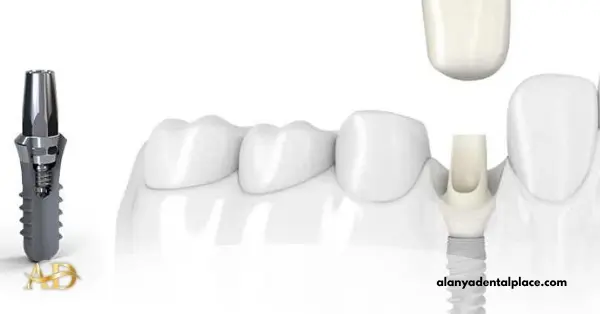
What is a screwless dental implant, and how is it different?
The name can be misleading, so here is what it means.
A standard implant has 2 main parts. The titanium implant is screwed into the jawbone, and a crown or bridge is fixed on top of it. With a ‘screwless implant’, the crown is fixed to the implant with a special dental cement instead of a screw. Dentists call this a ‘cement-retained’ or ‘cemented’ implant crown.
Many patients also use the term for flapless implant surgery. Here, the gum is not cut open in a large area, so stitches are usually not needed and recovery is often shorter.
Both are available at our clinic: crowns cemented without a screw, and less invasive flapless surgery.
Possible benefits of screwless implants
Who can have a screwless implant?
It depends on your own situation, but these general points apply.
Usually suitable:
- Enough bone density and bone volume
- Good general health, with any long-term condition under control
- Not smoking, or ready to stop
- Gums that are thick enough
Extra care is needed with:
- Severe bone loss (a bone graft may be needed)
- Diabetes that is not well controlled
- Current cancer treatment, or taking bisphosphonate medicines (a type of bone medicine)
- Severe teeth grinding or clenching at night (bruxism)
Important: flapless surgery needs enough bone volume. This is why we always take a 3D scan (CBCT) at the first examination. If there is enough bone, flapless surgery can be used. If not, we plan standard surgery, or a bone graft first. In every case, we decide on the right option together with you.
Contents
How screwless implant treatment works
Stage 1: 3D scan and digital planning
We make a 3D map of your jawbone from a panoramic X-ray and a 3D scan (CBCT). The dentist uses these images to plan the exact angle, depth and width of the implant. This means the position is planned before the implant goes into the bone. If needed, we can also do a digital smile design (DSD) at this stage. It lets you see a simulation of the planned result on screen.
Stage 2: making the surgical guide
From the plan, a 3D-printed guide is made to set the exact position of the implant. During surgery, the guide sits in your mouth and helps the dentist follow the computer plan. This reduces the risk of human error.
Stage 3: less invasive surgery
The dentist numbs the area with a local anaesthetic. Using the surgical guide, the dentist makes a small opening in the gum, or no cut at all. The implant itself is a titanium screw placed in the bone, just as with a standard implant. The difference is in the gum: there is no large cut and usually no stitches. For one tooth, this usually takes 20 to 40 minutes.
Stage 4: temporary or permanent crown
If your bone and the implant’s stability are good enough, a temporary crown is fitted on the same day. The implant then joins with the bone (osseointegration), which usually takes 3 to 4 months. After this, the permanent zirconia crown is fitted. Fixing it with a special cement instead of a screw means there is no screw hole on the crown.
Summary for patients travelling from abroad
| Visit | What happens | Time |
|---|---|---|
| Day 1 | 3D scan, consultation and planning | 1–2 hours |
| Day 2 | Surgery and temporary crown | 1–2 hours |
| Days 3–5 | Check-up | 30 minutes |
| Months 3–4 (remote) | Checking implant healing | Online |
| Second visit | Fitting the permanent crown | 1 hour |
For the permanent crown, you need one more short visit. Some people combine it with a holiday in Alanya.

What affects the cost of screwless implants?
After your consultation, you get a written plan that lists each item and its cost. No treatment starts without your approval.
Screwless or screw-retained: what is the difference?
The choice depends on clinical needs and on what matters most to you about appearance.
A cemented (screwless) crown is often better suited:
- For front teeth, where appearance matters most
- When the angle of the implant would bring the screw hole out on the visible surface of the crown
- When the gum line is especially important for appearance
A screw-retained crown is often better suited:
- When the implant angle lets the screw hole sit on the biting surface or the inner side of the tooth
- For large bridges, which must fit precisely, without strain
- When the crown or bridge may need to be taken off and put back in the future
Both options are available at our clinic, and we decide together which one is right for you.
Screwless implants at our clinic in Alanya
3D scans and digital surgical planning
Flapless implant surgery without 3D imaging and computer-assisted planning is risky. At our clinic, this technology is part of our standard process.
Temporary crown on the same day
With ‘immediate loading’, a temporary crown can be fitted on the same day. This is possible if the implant is stable enough when it is placed.
Experienced dentists
The flapless technique needs more experience and more advanced equipment than standard implant surgery. Our dentists have international training in implant dentistry.
Help with travel and your stay
Our coordinators can help with airport transfers, hotel suggestions and planning your appointments. You only need to book your flight.
Location: Alanya, Antalya
Alanya is on the Mediterranean coast, with a historic castle, beaches and a lively town centre. The implant takes 3 to 4 months to heal, and some people plan a short break around their visits.
Can an implant fail?
Yes, as with any surgery, an implant can fail. For suitable patients, studies have found that flapless surgery gives similar results to standard implant surgery.
The result depends mainly on the implant quality, careful surgical planning, your general health and how well you clean your teeth. We plan each treatment with all of these in mind.
5 common myths about screwless implants
Send us a message to ask about an initial assessment and a treatment plan for screwless implants at our clinic in Alanya.
Our clinic is in Alanya, in Antalya province.





Frequently asked questions
Questions about treatment
‘Screwless implant’ usually means that the crown is cemented onto the implant instead of being screwed on. It is often combined with flapless surgery, with no large cut in the gum and usually no stitches. Compared with the standard method, it is less invasive, recovery is often shorter and the crown has no screw hole. It is not suitable for everyone, so your bone density must be checked first.
The procedure is done under local anaesthetic, so you should not feel pain during it. With no large cut or stitches, pain and swelling afterwards are usually less than after standard surgery. Many people can eat comfortably the same evening.
The cost depends on your treatment plan. Your exact cost is set after a 3D scan (CBCT), in your written treatment plan.
Every surgery has risks. With careful patient selection and 3D planning, flapless surgery is a well-established method. Surgical guides help reduce the risk of error. Studies published by international implant associations show results similar to standard surgery.
Yes, in suitable cases. With ‘immediate loading’, a temporary crown is fitted on the same day. Your bone must be good enough and the implant stable. The permanent crown is fitted once the implant has joined with the bone, after 3 to 4 months.
For one tooth, the surgery usually takes 20 to 40 minutes. The 3D scan and planning take extra time. If you travel to us for treatment, the first stage is usually done in 2 to 3 days.
The implant itself is designed for long-term use, and studies have followed implants for more than 20 years. A cemented crown can last 10 to 15 years or longer, depending on the materials and how well you clean your teeth.
Then flapless surgery is not possible. A bone graft is usually planned first. Once enough bone has formed, usually after 4 to 6 months, the implant is placed. Tilted implants or All-on-4 may also be options.
Smoking makes it harder for the implant to join with the bone and raises the risk of failure. It does not always rule out implants. But we strongly recommend that you stop at least 2 weeks before and 2 months after surgery. Please talk to our dentist about your situation.
For the first visit, 3 to 5 days is usually enough. You need a short second visit about 3 to 4 months later for the permanent crown. Some people combine this visit with a holiday.
- World Health Organization (WHO) – Oral Health Global Status Report
https://www.who.int/publications/i/item/9789240061484 - FDI World Dental Federation – Implantology Standards and Guidelines
https://www.fdiworlddental.org/ - International Journal of Oral & Maxillofacial Implants – Flapless implant surgery outcomes: a systematic review
https://quintpub.com/journals/omi/ - Clinical Oral Implants Research – Cement-retained vs. screw-retained implant restorations: a systematic review (Wiley)
https://onlinelibrary.wiley.com/journal/16000501 - Journal of Clinical Periodontology – Peri-implant health, peri-implant mucositis and peri-implantitis: Case definitions
https://onlinelibrary.wiley.com/journal/1600051x - Cochrane Oral Health – “Interventions for replacing missing teeth: implants for single teeth”
https://www.cochranelibrary.com/ - European Association for Osseointegration (EAO) – Consensus Report on Immediately Loaded Implants
https://www.eao.org/ - International Team for Implantology (ITI) – Consensus Statements on Flapless Implant Surgery
https://www.iti.org/ - Journal of Prosthetic Dentistry – Digital workflow in implant prosthodontics
https://www.thejpd.org/ - Turkish Association of Oral and Maxillofacial Surgery (TOMS) – Clinical practice standards
https://www.toms.org.tr/
Do you have any other questions?